
.svg)

.svg)
%203.svg)


The Second-Order Effects of Indian Commerce

India can be compared to Lilliput Land (as Rama Bijapurkar's book puts it well) with lots and lots of small consumers, each earning and spending just a little bit, that adds up to an enormous amount. Google and Deloitte now put that amount at $90B, heading to $250B by 2030. But beyond the sheer size, what is interesting is understanding the mechanics underneath. To make sense of it, I map the commerce journey as seen above, and under Marketing and Sales I have split it into three layers: pre-purchase, at-purchase, and post-purchase. Within each, there are certain themes worth paying attention to over the next five to ten years. So let's get into it.

1. Pre-Purchase
When we map the commerce journey (brand to consumer), the first layer is Marketing and Sales. Within that sits the pre-purchase phase which is everything that happens before a buyer decides to buy. And within pre-purchase is Search and Discovery: how products find people, and how people find products.
One of the more interesting/contested themes sitting inside Search and Discovery has been live commerce.
When you hear “Live Commerce,” you probably think: dead space.
You’re not entirely wrong.
Between 2019 and 2023, a lot of capital went into this category in India. Partly COVID-driven, partly China-inspired. Bulbul, SimSim, Trell, Meesho Live, the Moj-Flipkart partnership, ShareChat’s commerce vertical. All raised, all launched, and all tried. But by 2023, most of it had unravelled. SimSim shut down less than 2 years after YouTube acquired it. Trell’s revenue fell 94%. The Moj-Flipkart partnership wound down. Meesho killed its live product and called the pivot “Video Finds.” ShareChat shut its live commerce vertical entirely.
The easy read here is that it’s a “failed space.” But that’s not quite right. A specific approach failed, one that was largely borrowed from China and applied to a market that wasn’t structurally set up for it in the same way.
Why it actually failed
Let’s dig into the why.
- COD broke the core mechanic.
Live commerce is an impulse format. It only works if the buyer commits at the moment of peak excitement. China, an inherently prepaid market (Alipay and WeChat Pay), meant the gap between wanting something and buying was seconds. In India, 64% of all e-commerce orders were still COD in 2021, which meant the real commitment happened two days later at the doorstep, in a completely different emotional state. High return rates are a fact of life in Indian fashion e-commerce anyway, but what live commerce faced was worse than a return. A return is a completed prepaid sale that gets reversed, absorbed inside marketplace economics built to handle it at scale. A COD refusal is a sale that never happened at all, with the seller eating forward and reverse logistics on zero revenue. And live commerce stacked those refusals on top of a cost structure marketplaces never carry: the creator fee, the streaming infrastructure, and the marketing spend already burned to pull viewers into that specific stream. Impulse decays harder than intent, so refusal rates ran structurally higher than catalog shopping to begin with. The unit economics had no path to working.
- No super-app meant the funnel leaked at every seam.
China worked because WeChat, Taobao, and Douyin kept you inside one ecosystem where you watch, click, pay, and you are done. India had no equivalent. Every time a viewer had to leave an app to complete a purchase, a large chunk didn’t come back. No platform built the closed loop, and the conversion bled out at every handoff.
- Live commerce got short-circuited and India jumped straight to quick commerce.
By the time live commerce launched aggressively in 2020-2021, Indian consumers had spent 2 years on TikTok and were immediately re-hooked onto Reels, Moj, and YouTube Shorts after the ban. Their content behavior had already been trained on 30 to 60 second clips, and the loop that has formed around it now is simple: discover it on Reels, order it on Blinkit. India leapfrogged the live commerce phase that China went through between 2016-2019. Live commerce needed 36 minutes of committed viewing time per session, a behavior Taobao had spent the better part of a decade building. Sitting through a 30 minute live stream to buy one item was a fundamentally different ask, and in a market where that habit had never been built, it was unrealistic.
However, the Ground Has Shifted.
- UPI fixed the COD problem.
Prepaid digital payment is now default behaviour for 400M+ users (UPI now processes 21B+ transactions monthly). The infrastructure gap is closing on the supply side too. India’s internet infrastructure in 2019 to 2022, when most live commerce attempts happened, was unreliable in Tier 2/3 cities. Buffering during a live sale is fatal because it kills urgency and trust simultaneously. With Jio’s 5G rollout now reaching smaller cities and home broadband penetration rising, the technical floor for a watchable, smooth live stream has finally arrived in the markets that actually need convincing.
- WhatsApp live commerce is already working… just informally.
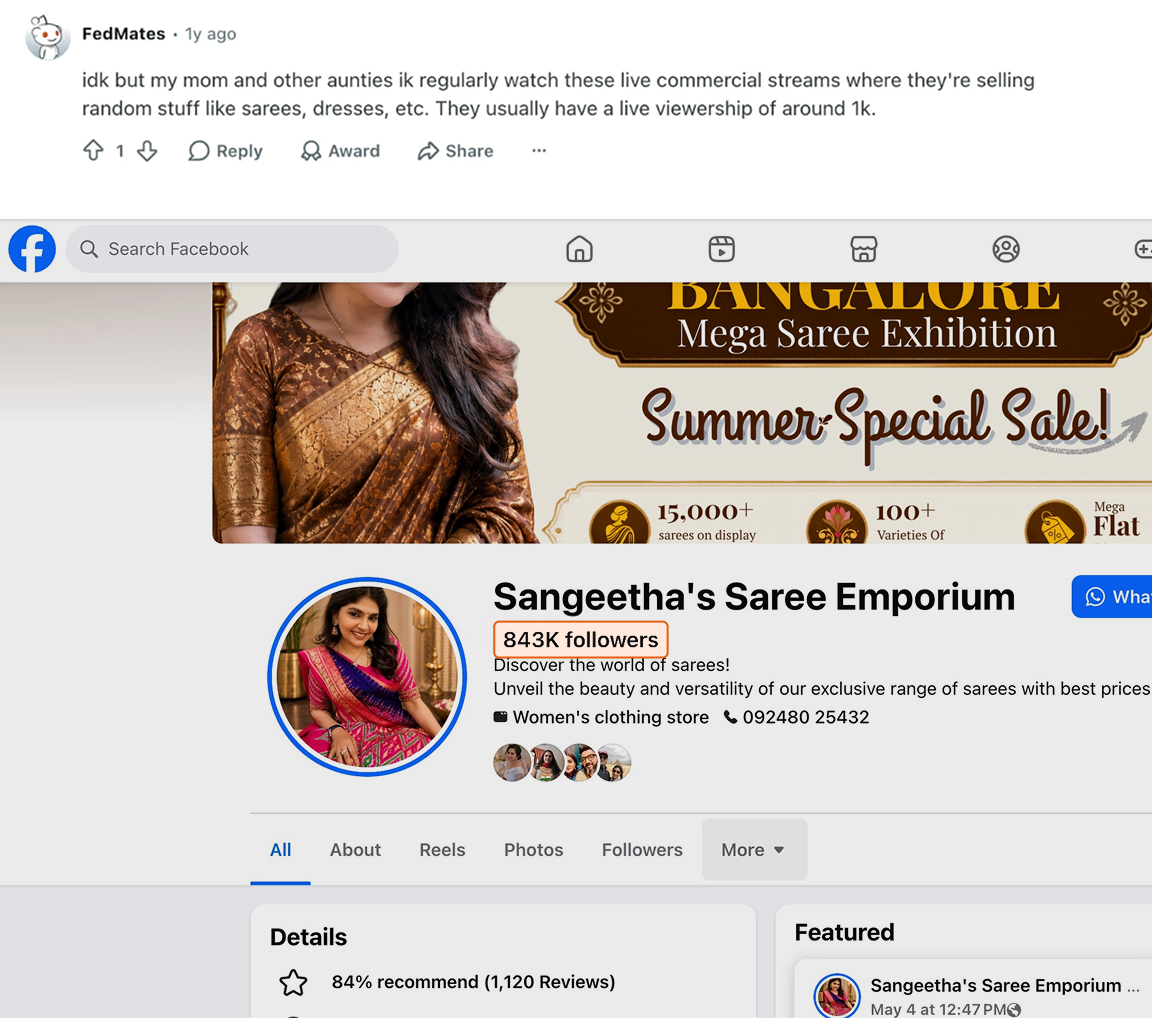
WhatsApp live commerce already exists in India. There is a whole subset of sellers where discovery happens on Facebook or Instagram Lives and orders come in through WhatsApp. Saree vendors, jewellery makers, local artisans have been building real repeat buyer communities this way for years. Sellers like Sangeetha Rajesh have built entire businesses on the back of this model (850,000 Facebook followers, 80,000 live viewers per session). No app, no checkout flow, no platform. Just a live stream and a WhatsApp group. The demand is real and it has been proven. It just hasn’t been built around properly.
- The first wave chased push. The real opportunity is pull.
The first wave chased the China playbook of push categories, low AOV fashion, manufactured urgency. What is working now is the opposite. Jewellery, electronics, premium apparel etc. are pull categories. The buyer is already in market but needs to see the product, understand it, and trust the seller before spending serious money. A live seller resolves that doubt in a way a product page never can. And they can often walk away with a better deal too.
What’s worth watching:
- The first interesting build is a platform that lets a seller go live once across Facebook, Instagram, and YouTube simultaneously, consolidates all orders and DMs into one place, and uses AI to handle the cataloguing and haggling loop in real time. The multi-platform chaos that every live seller navigates manually today is a real problem and a real product gap.
- The second theme is gamified live commerce. Buyers can place real time bids on limited inventory, creating a fundamentally different dynamic from anything the 2020 to 2023 wave attempted. Real scarcity, real competition, and the social thrill of winning. Nobody has built this seriously in India yet, but the West has already shown what it looks like at scale. Whatnot, the US live auction platform, did $3B in GMV in 2024 and crossed $8B in 2025, built on exactly these categories: sports cards, collectibles, sneakers, vintage fashion, and jewellery, with jewellery alone growing 259% last year. The Indian equivalents write themselves. Sarees, handloom, temple jewellery, antiques, artisan ceramics. The categories where a live auction earns its urgency already have deep seller communities on Facebook and WhatsApp. What they don’t have is the bidding rail.
2. @ Purchase
The next layer under Marketing and Sales is at-purchase. The theme sitting inside it is agentic commerce. There is a deliberate reason it sits here rather than in the pre-purchase layer. Better discovery, smarter recommendations, more personalised search are all pre-purchase improvements, and a single Claude/Cowork prompt can now largely collapse that entire layer. What is more interesting is what happens at the moment of transaction/checkout itself, and what the specific wedge for agentic commerce actually looks like. That is what we get into next.
Agentic Commerce = “The Klarna Effect”?
An AI agent, in the most elementary terms, is software that acts on your behalf. You tell it what you want, it figures out how to get it done. In commerce specifically, that means it finds the product, compares options, applies discounts, picks the payment method, and confirms the order. You set the intent and the agent executes.
What makes this theme genuinely fascinating is that it is a 3x Win. Merchants see higher conversion and bigger baskets. Customers get a low-admin, deeply personalised experience with less decision fatigue. And the infrastructure providers powering it all take a slice of every transaction they enable. This mirrors the “Klarna effect”: just as BNPL created its own 3x Win that transformed checkout conversion, agentic commerce is set to do the same.
Agentic Commerce could work well… but in very specific wedges
Being precise about where agentic commerce could actually work is important.
The way we think here is that there are 3 clear specific wedges:
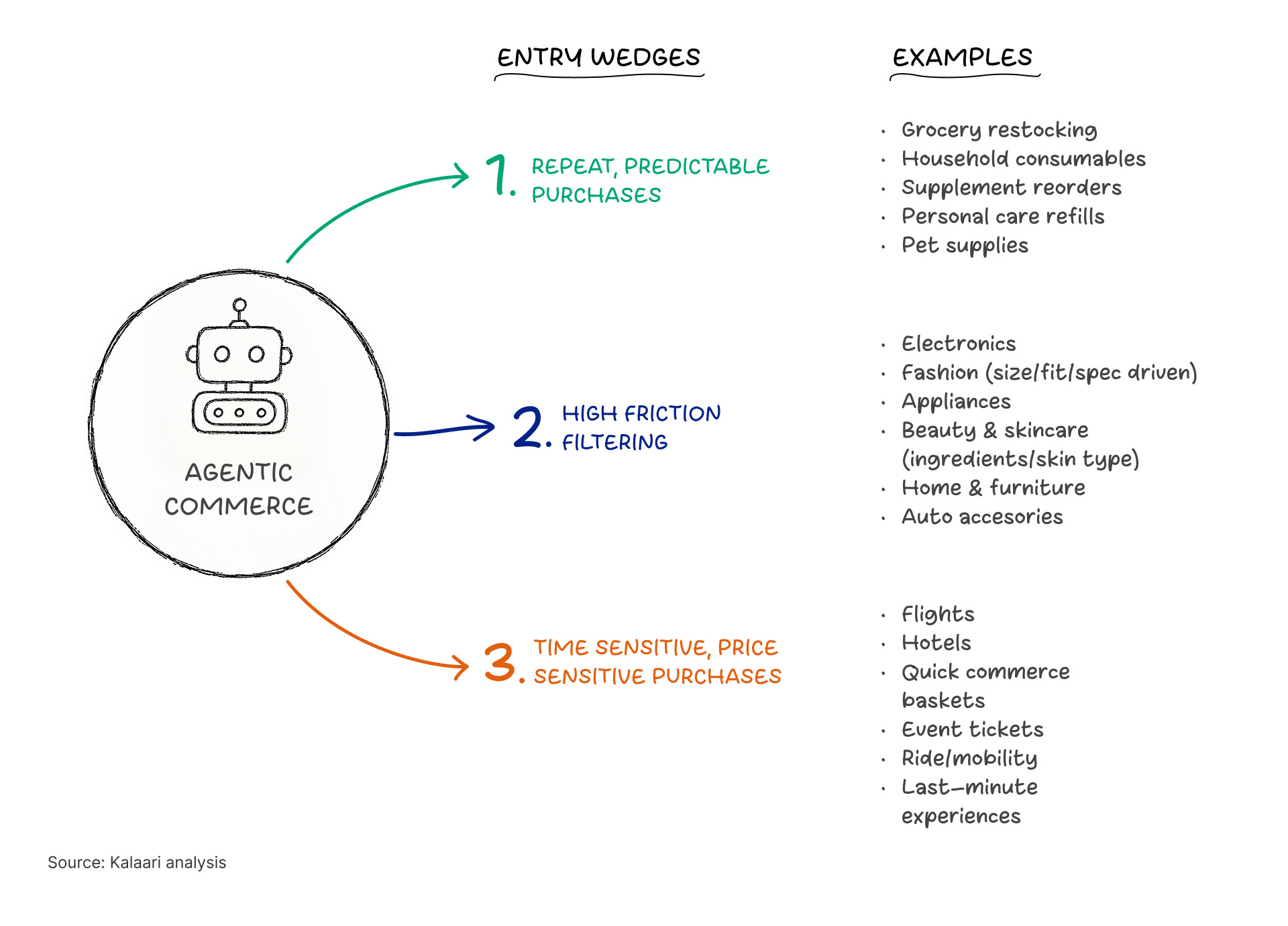
- Repeat, predictable purchases: Grocery restocking, household consumables, supplement reorders where the SKUs are known, the cadence is regular and the price sensitivity is high. There is no discovery needed here and the agent just needs to execute. Think of it as the CamelCamelCamel problem: you already know you want the same laundry detergent, you just want someone to monitor the price and buy it when it dips. But price is only the crude version. The real unlock is an agent that learns how your household actually consumes, groceries every weekend, household items every fifteen days, and automates the reorder against that behavior without you setting a rule. That is a perfectly automatable task, and it is where agentic commerce could work very well today.
- Categories with high friction filtering: These categories contain products where size, ingredients, or specs matter (electronics, ingredients) and where a buyer today opens fifteen tabs, compares endlessly, and still isn’t sure. The agent’s value here isn’t in making the decision but in removing the forty-five minutes of work that precedes it.
- Time-sensitive, price-sensitive purchases: Flights, quick commerce baskets, event tickets are verticals where comparing across platforms in real time and executing within a narrow window has clear, measurable value. The agent that assembles your weekly grocery basket across Blinkit/Zepto, optimises for price and delivery window, and executes before you’ve opened an app could be a genuinely useful product.
…But all of this only works if the merchant is visible to the agent in the first place, aka the “agent readiness” problem
Most aren’t. The average product page today is built for human eyes. (Images, marketing copy, unstructured descriptions.) An AI agent querying that page cannot reliably extract price, availability, return policy, or specs. Shopify has already rolled out Agentic Storefronts that syndicate product data to ChatGPT, Perplexity, and Copilot. The rails are being built at the top of the market. But India has 63M MSMEs and roughly 200,000 to 250,000 D2C brands, and McKinsey projects MSMEs will drive nearly half of incremental e-commerce growth to 2030. Almost none of them have a structured catalog, an MCP server, or an API layer. They will be invisible to agents by default.
What’s worth watching:
- Seller agentic infrastructure (especially for MSMEs and Kiranas):As covered above, the agent readiness problem is unsolved for the long tail of Indian commerce, and it runs deeper than catalogs. Most of these sellers have no machine readable inventory, no pricing truth an agent can query, and no trust signals an agent can reason over. Building the tooling to fix that, catalog structuring, a simple API layer, pre-configured MCP servers for MSMEs and Kirana stores, with rails like ONDC as just one distribution channel, is an important infrastructure play within Indian agentic commerce right now..
- Post-purchase agentic commerce (beyond checkout): For example, a COD to prepaid conversion engine in the form of an agent that reduces RTO and converts COD orders to prepaid through intelligent trust-building conversational flows. Or a cart abandonment agent that instead of firing a templated email, reasons about when to reach out, how, and what to say. Sellers on Amazon and Flipkart report RTO rates averaging 30%, with ₹22 of every ₹100 earned lost annually. Nobody has built this cleanly (yet).
3. Post Purchase
The post-purchase layer is everything that happens after a buyer completes a transaction. Retention, re-engagement, and the relationship a brand builds with a customer after the sale. What if I told you every ₹1 a merchant spends on loyalty points translates into ₹2 to ₹3 of redemption value for the user? That asymmetry is exactly why rewards and loyalty, a space that saw significant excitement in the early 2010s, is worth paying close attention to again today.
You Earned It. Good Luck Finding It.
Every time an Indian consumer completes a purchase, something gets earned. A cashback here, loyalty coins there, SuperCoins on Flipkart, reward points on a credit card, affiliate cashback still processing somewhere. None of it talks to each other. Each program lives in its own app, its own wallet, its own redemption logic. 78% of Indian shoppers actively hunt for rewards programs and try to maximise their points. But the infrastructure to actually do that does not exist. There is no unified view of what you have earned, what is about to expire, or how to stack it on your next purchase.
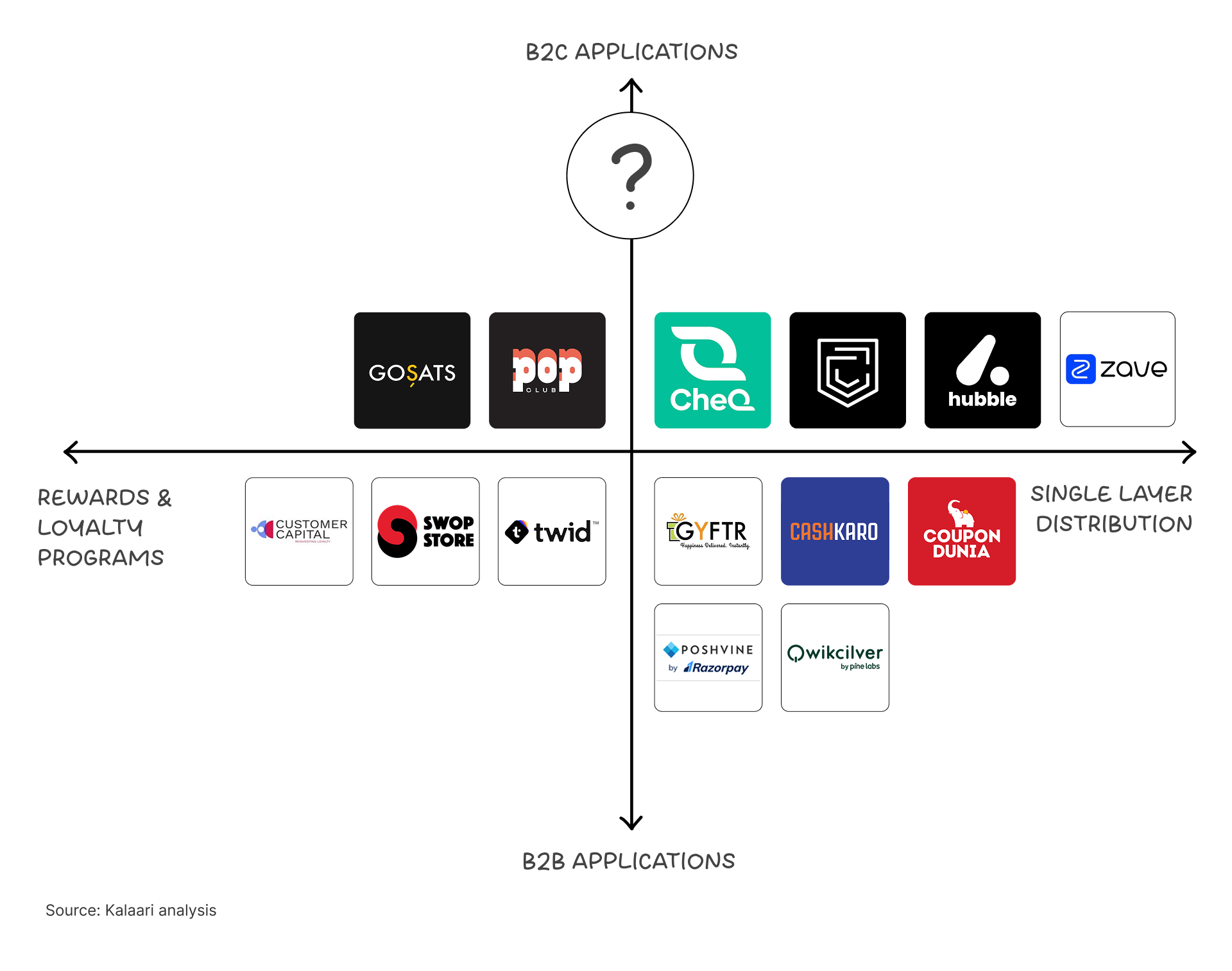
As seen in the diagram above, India is missing a “savings OS,” a layer that sits on top of checkout, aggregates every incentive, and applies the optimal mix in one tap.
And This Whitespace Has Been Filled Before… Just Not in India (Yet)
The West figured this out a long time ago. Airline and hotel loyalty programs became so valuable they started trading at premiums to the parent company itself. American Airlines’ AAdvantage program was valued at $18-30B during COVID, more than the airline. Marriott Bonvoy has 196M members. The loyalty currency became the business. In India, the closest equivalent is credit card reward points, structured, gamified, deeply valuable, but only 103M Indians hold credit cards. The other 350M UPI users are making 14-15B transactions a month and earning scratch card cashbacks worth ₹5-₹25 in return. Consumers have learned the value of points. They just cannot earn them on the rail they use ten times more often.
What’s worth watching:
- A platform that sits on top of existing savings infrastructure, aggregating gift cards, affiliate deals, and payment mode optimisation at checkout, but pays out in a proprietary points currency rather than cash. The consumer gets more long-term value; the platform earns the right to issue and control a loyalty currency with real redemption utility. One early player assembling these layers in India is Maximize, which stacks savings at checkout and converts them into MaxCoins redeemable against airlines and hotels. The model is early, but the thesis is right: whoever builds the savings OS first earns the loyalty
- On the consumer side, the interesting build is a taste graph, not a referral program but a reputation layer. The person who has recommended twelve things and converted nine of them should have a fundamentally different relationship with brands than someone who shared once for a discount. That identity compounds over time and is worth something. On the merchant side, the infrastructure play is simpler but real: tooling that triggers the share at peak satisfaction, routes it through WhatsApp, pays out via UPI, and gives the brand visibility into which customers are actually driving word-of-mouth GMV. Both are early. Neither is built cleanly yet in India.
This piece is more of a brainstorm. If we have missed something obvious, overcomplicated something simple, or you are building in commerce, we would love to hear from you. Drop a comment or write to us at consumer@kalaari.com and/or sana@kalaari.com.
Part 2 covers the backend and supply side of Indian commerce. Stay tuned!


.svg)

.svg)

More
BLOGS
.png)