


.svg)

.svg)
%203.svg)


The Quantum Trifecta: India's Race Across Three Clocks

In August 2024, National Institute of Standards and Technology, US (NIST) finalized its first quantum-proof cryptographic standards, and mandated every US federal agency to adopt them. Within twelve months, IBM, Google, and Microsoft each committed quantum hardware delivery dates. Not “someday,” but 2027, 2029, 2033. Following the chain of events, Japan committed $7.4 billion in 2025, one of the largest quantum investment by any country outside China. India’s National Quantum Mission committed ₹6,003 crore (~$650 million) through 2031 to build R&D and industrial capability across quantum computing, communication, sensing, and materials.
In 2025, Google’s Willow chip completed a calculation in five minutes that would take the world’s fastest supercomputer 10 septillion years. Not incrementally faster, a fundamentally different class of computation, one that classical machines cannot replicate regardless of how much hardware you add.
These events point in the same direction, one a vulnerability only quantum hardware can close, the other a capability only quantum hardware can deliver. Sensing, communication, computing: the shift is happening across all three at once. Countries that build this capability early won’t just win a technology race. They will compound that advantage the way semiconductor and internet leadership did before them. Governments have committed over $55 billion to make sure they are in that group. India is building across all three fronts. This is what that looks like.
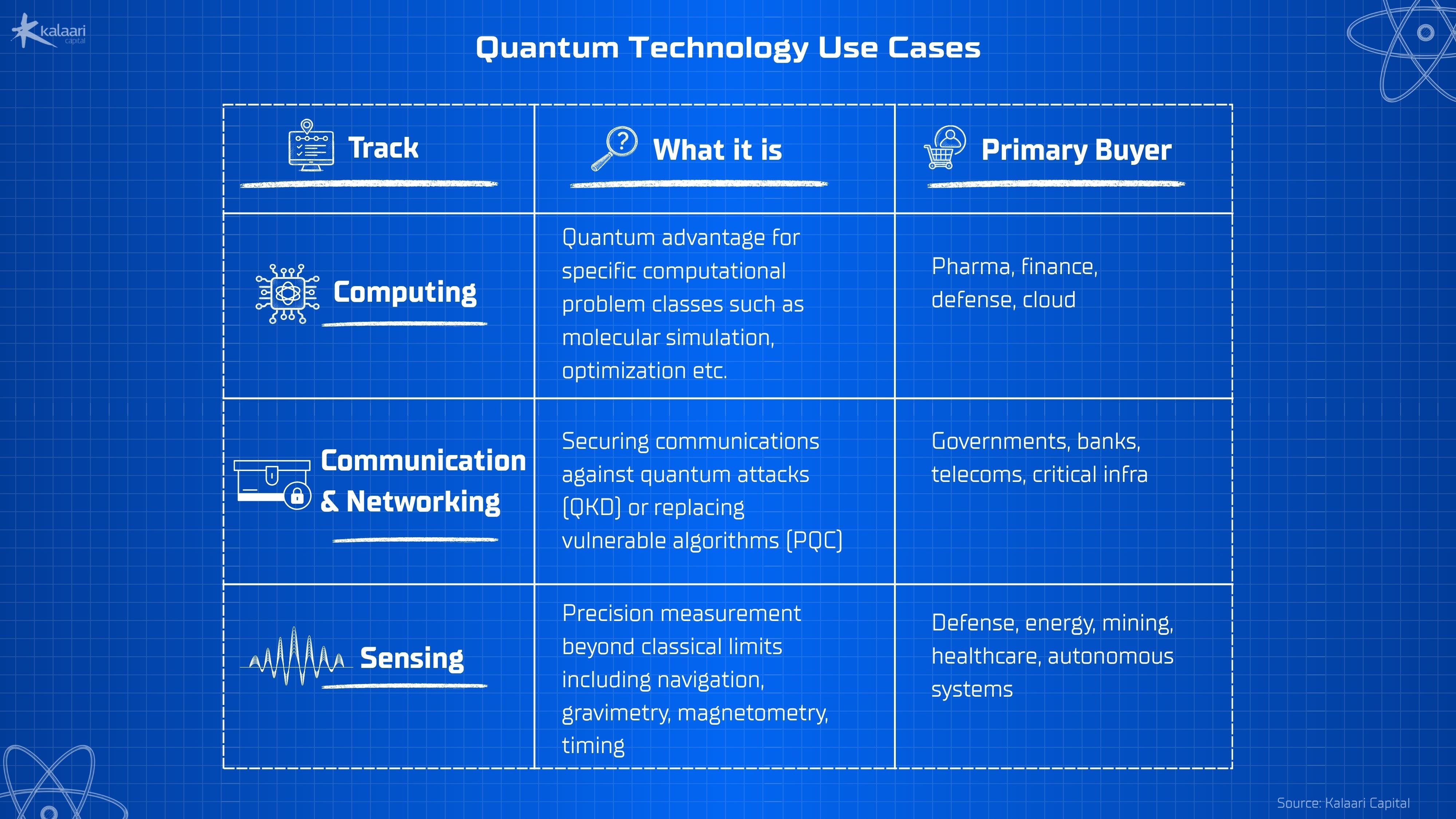
Classical Computers vs Quantum: What Actually Changes?
Every computer ever built works on the same foundation: information stored as bits, each either 0 or 1, processed one step at a time. More speed means more steps per second. For most problems, this is enough.
Quantum physics governs how matter and energy behave at the atomic scale. At that scale, particles can exist in multiple states simultaneously, and their states can be manipulated with extraordinary precision. These properties have been known for over a century. What changed in the last decade is our ability to harness them in hardware, building systems stable enough to control individual quantum states reliably at scale.
The basic unit of quantum information is a qubit. Like a classical bit, it can represent 0 or 1. Unlike a classical bit, it can exist in both states simultaneously until measured. This is not an engineering trick. It is a fundamental property of nature.
Several quantum properties set qubits apart from classical bits. Three in particular underpin the applications we will cover, sensing, communication and networking, and computing:
Superposition: a qubit exists in multiple states simultaneously, allowing a quantum system to represent and operate on vastly more possibilities at once than any classical system.
Entanglement: interacting qubits become inseparably linked, describable only as a whole, giving quantum systems an exponential information capacity no classical system can replicate.
Interference: quantum states behave like waves, reinforcing or cancelling each other. Algorithms use this to amplify correct answers and suppress wrong ones across all possibilities simultaneously.
From computing to communication and networking to sensing, these properties are unlocking capabilities that classical approaches fundamentally cannot match, and that is what the rest of this newsletter unpacks.
How quantum thinks differently: the delivery problem
Imagine finding the shortest route across 50 Indian cities such as Mumbai, Delhi, Bengaluru, Chennai and 46 others. Simple to state. Extraordinarily hard to solve from a compute perspective.
A classical computer approaches this sequentially. It evaluates one complete route (if you consider a brute force approach), records the distance, then moves to the next. The number of possible routes is 49! roughly 6 × 1062. Even at a trillion calculations per second, the world’s fastest supercomputer would take longer than the age of the universe to guarantee the best answer. So in practice, classical computers don’t actually solve this, they approximate, using smart shortcuts to find a route that is good enough, not optimal.
A quantum computer does something fundamentally different, and it starts before the first city is even chosen.
Using a property called superposition, each qubit can exist in multiple states simultaneously. When qubits interact, they become entangled, their states are no longer independent, they can only be described as a whole system. Every one of the 49! routes exist in the quantum state at once, not as separate computations running in parallel, but as one unified quantum state the algorithm then sculpts toward the optimum.
A mature quantum computer running structured optimisation algorithms (QAOA, quantum annealing) is projected to return a near-optimal route in hours to days.
Now the algorithm goes to work. It applies quantum interference, the same phenomenon that causes waves to reinforce or cancel each other, across the entire solution space simultaneously. Routes with long distances have their probability amplitudes suppressed. Routes with short distances have their amplitudes amplified. With each round of interference, the wrong answers get quieter and the right answer gets louder. When you finally measure the system, the optimal, or near-optimal, route is the one most likely to emerge. (While this is an oversimplification of how the quantum stack actually works, it just gives a view of the process.)
This is not faster classical computing. It is not more cores running more routes in parallel. It is a physically different model of computation, one where the answer is sculpted out of the relationships between particles, not assembled sequentially from individual calculations.
Quantum is not a universal upgrade on classical computing, it is a specialist. Classical computers remain faster and more practical for the vast majority of tasks. Quantum's advantage is categorical in a specific set of problems: those involving combinatorial search across astronomical solution spaces (problems where the number of possible solutions grows factorially or exponentially with scale, routing, scheduling, portfolio optimisation), simulation of nature at the atomic level, and the mathematical structures underpinning today's encryption and security. The disruption is not that quantum does everything better. It is that the problems quantum does better happen to be some of the most consequential ones, in defence, drug discovery, financial systems, and the security infrastructure the modern world runs on
Why Now? The Engineering Bottleneck That Just Broke
Quantum physics has been settled science for a century. The problem was never the theory. The challenge was engineering, you could not build a company on it.
Like we stated earlier, Quantum computers use qubits, that exploits superposition to exist in multiple states simultaneously. The catch: a qubit holds its quantum state only when almost perfectly isolated from the outside world. A stray photon, a vibration in the floor, a temperature shift of a fraction of a degree, and the state collapses. This is called decoherence. For decades, it made quantum a lab curiosity with no commercial path.
IBM and Google now run processors at 15 millikelvin, colder than outer space, inside dilution refrigerators that did not exist at production quality a decade ago. Even then, errors compounded: every qubit added made the system noisier. In late 2024, Google’s Willow chip broke that cycle, adding more qubits actually reduced errors instead of compounding them, a threshold chased for nearly thirty years. The path to larger machines became engineering, not physics. The commercial era of quantum has begun.
Quantum Is Not One Market
The quantum properties we discussed, superposition, entanglement, and interference, don’t just enable one new technology. They enable a fundamentally different approach to several hard problems that classical systems have hit a wall on. From measuring the physical world with unprecedented precision, to securing communications in ways mathematics alone cannot guarantee, to processing problems classical computers cannot touch, the applications span multiple industries and multiple timelines.
We can broadly bucket the most compelling of these opportunities into three areas, each at a different stage of maturity, and each opening up a distinct set of possibilities.
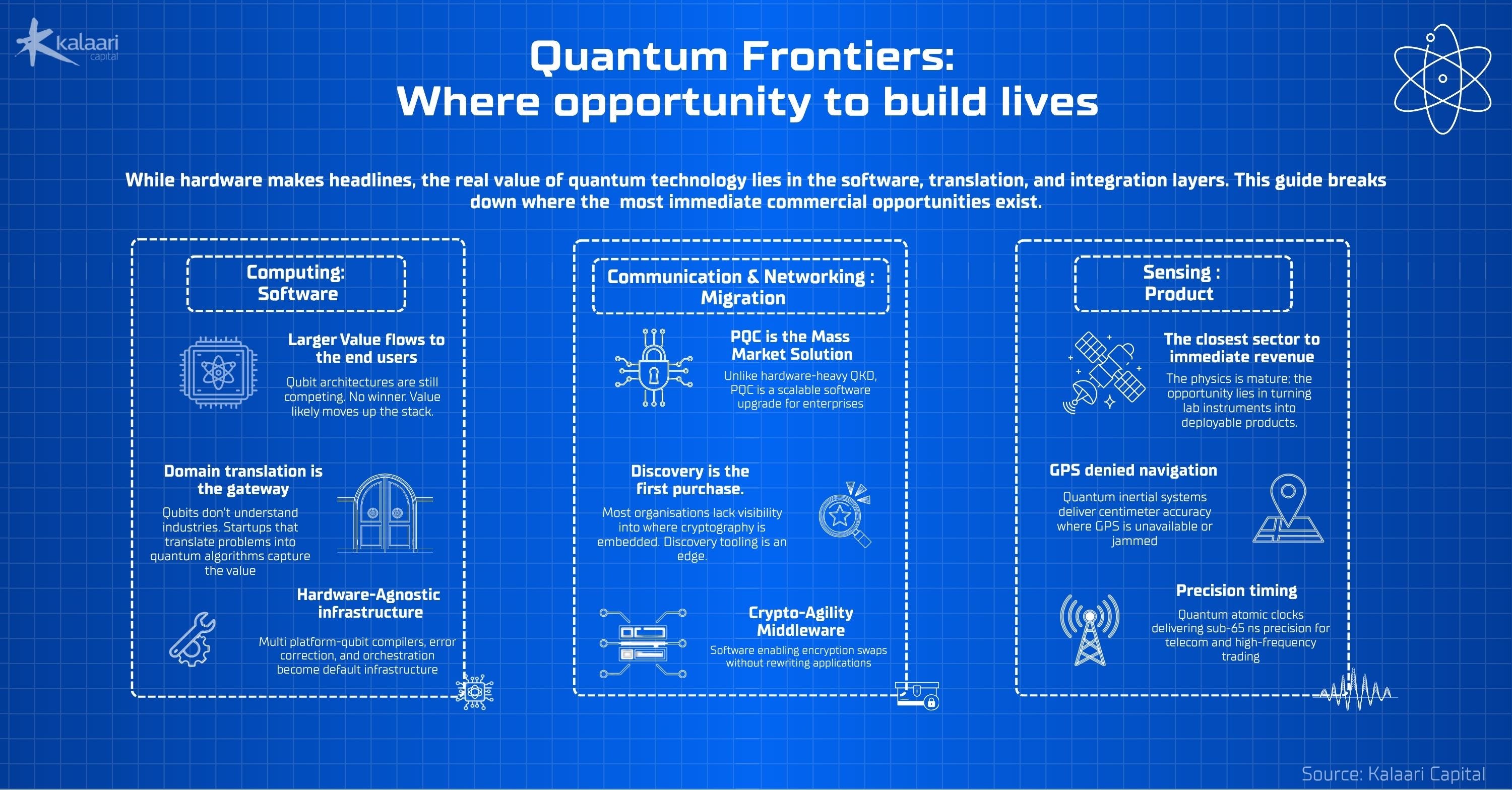
Quantum Sensing
Every measurement we make today depends on an external reference, a GPS signal from space, an electrical current through a sensor, a chemical reaction in a detector. These systems are only as reliable as the signal they receive, which means they can be disrupted, spoofed, or degraded.
What makes quantum systems fundamentally different as sensors is rooted in the same properties we discussed earlier. A quantum state in superposition is exquisitely sensitive to its physical environment, a fractional change in gravity, a weak magnetic field, a tiny shift in acceleration all cause measurable, precise shifts in that state. Rather than measuring how an external signal affects a material, quantum sensors measure how the environment disturbs a quantum state directly, tied to universal physical constants. The result is a precision that classical sensors cannot approach, and a measurement that does not depend on any external infrastructure that can be jammed, spoofed, or denied.
This opens up application areas across several industries that have historically been constrained by the limits of classical sensing:
Atom interferometers use quantum superposition to measure acceleration and rotation with a sensitivity orders of magnitude beyond classical gyroscopes, enabling navigation that works in GPS-denied environments, underground, or in contested airspace. The defence and aerospace sectors are already the largest buyers, with the quantum navigation market projected to reach $2.5 billion by 2030.
Gravity sensors detect gravitational gradients at sensitivities that reveal subsurface structures classical gravimeters miss entirely, mapping tunnels, mineral deposits, and oil and gas reservoirs without drilling. The oil, gas, and mining industries are early adopters, with quantum gravimeters already being deployed on survey aircraft and drones.
Magnetometers detect magnetic fields at the femtotesla level, opening up applications in medical imaging, non-invasive brain scanning without superconducting magnets, EV battery diagnostics, geological surveying, and detection of submarines and underground infrastructure.
Quantum-enhanced atomic clocks build on classical atomic clocks, which already underpin GPS and telecoms, by using optical transitions and quantum techniques to push timing precision orders of magnitude further. The applications range from autonomous navigation systems that do not depend on satellite timing, to financial settlement infrastructure, to next-generation communications networks.
The global quantum sensors market is valued at approximately $760 million in 2025 and projected to cross $1.5 billion by 2031, growing at roughly 13% CAGR. Defence and security account for the largest share at around 40%, with healthcare, oil and gas, and automotive growing rapidly behind it.³ India’s quantum sensors segment is projected to grow at 18.8% CAGR between 2025 and 2035, driven by defence, space, and navigation demand.
Quantum Communication and Networking
Every piece of sensitive data travelling the internet today, bank transactions, government communications, medical records, military coordination, is protected by a mathematical lock. That lock works because the mathematical problems underlying it are so hard that no classical computer could crack them in any reasonable timeframe.
Quantum computers, running Shor’s algorithm, can solve those same problems in minutes. The lock doesn’t get harder to pick, it dissolves entirely. And this is where cryptography, the foundation of all digital security, faces its most fundamental challenge since the internet was built.
In fact, today, adversaries do not need to wait for a quantum computer before acting. Encrypted data can be intercepted and stored now, then decrypted the moment the hardware arrives. The Federal Reserve described this, in a 2025 paper, as a “present and ongoing” threat, not a future one. Sensitive communications captured in 2026 could be readable by 2032. The breach isn’t visible when the data is stolen. It becomes visible years later, when the encryption protecting it collapses. This is harvest now, decrypt later, and it is already in motion.
The response to this threat is playing out across three interconnected areas. Post-quantum cryptography is the immediate play, migrating today’s encryption to quantum-safe equivalents on existing infrastructure. QKD goes further, replacing mathematical security with a physical one, making eavesdropping detectable by the laws of nature rather than the difficulty of mathematics. And quantum networking is the long-term infrastructure shift, building communications on entanglement itself, eventually enabling a quantum internet that doesn’t just secure data but fundamentally changes how it moves.
Post-quantum cryptography addresses the migration challenge head on. NIST finalised the first global standards in August 2024, and the clock is now running, with mandates cascading from government through defence contractors, banks, and telecom vendors. The PQC market is projected to grow from $420 million in 2025 to $2.84 billion by 2030, at a 46% CAGR. India’s own financial sector tells the scale of the challenge, a 2025 ISB study found that India’s BFSI sector scores just 2.4 out of 5 on PQC preparedness, even as over half of CISOs anticipate significant quantum security threats within three years.
QKD takes a fundamentally different approach. Rather than making encryption harder to break, it makes eavesdropping physically detectable. Keys are transmitted using individual photons, and any attempt to intercept them disturbs the photons in a measurable way, unbreakable not because the mathematics are hard, but because the laws of physics make interception visible. India’s QNu Labs has already deployed a 1,000km QKD backbone on standard telecom fibre, announced in April 2026, one of the longest such networks in the world.
Quantum networking is the third and most consequential long-term layer. A quantum network doesn’t transmit data the way the classical internet does, it distributes entangled quantum states between nodes, enabling communication protocols that are impossible to intercept by any means. The eventual destination is a quantum internet that connects quantum computers the way TCP/IP connects classical ones. The infrastructure being built today, quantum repeaters, satellite QKD, free-space links, is the foundation layer of that internet.
The scale of what is at stake is clearest in telecom. 5G and 6G signalling traffic represents encrypted data moving at enormous scale, making it the largest single harvest-now-decrypt-later target in the world. The GSMA has formed a Post-Quantum Telco Network Taskforce. 3GPP and ETSI are embedding NIST algorithms into LTE/5G protocols. India’s telecom sector alone, with over 750 million mobile subscribers, represents one of the most consequential migration challenges and opportunities anywhere.
Quantum Computing
Classical computers have become extraordinarily powerful, but there is a class of problems where raw speed is not the constraint. As we discussed earlier, problems involving combinatorial search, atomic-level simulation, and certain mathematical structures require a fundamentally different computational model. Quantum computing is that model, and the applications it unlocks, drug discovery, materials design, financial modelling, logistics optimisation, climate simulation, span almost every major industry.
The nearest-term of these is simulation and materials discovery. Modelling how a molecule behaves at the atomic level is something classical computers can only approximate, because the underlying physics is quantum mechanical. A quantum computer simulates it as nature actually works. Drug discovery that takes 15 years in a lab could take months. Battery chemistry, semiconductor design, fertiliser synthesis, entire industries built on physical trial and error could be rebuilt on computational modelling. Pfizer, Roche, and BASF are already running early quantum chemistry experiments for exactly this reason.
The hardware to deliver this reliably, what the field calls fault-tolerant quantum computing, is still years away, and four distinct architectural approaches are competing to get there first.
Superconducting circuits (IBM, Google) use loops of superconducting metal cooled to near absolute zero to create qubits. The most commercially mature approach today, with the largest qubit counts, but requires extreme cooling infrastructure that is difficult to scale.
Trapped ions (Quantinuum, IonQ) suspend individual atoms in electromagnetic fields and manipulate them with lasers. Naturally high fidelity and long coherence times, but slower gate speeds and harder to scale to large numbers of qubits.
Photonics (PsiQuantum, Xanadu) use particles of light as qubits, which can operate at room temperature and travel through standard fibre. Scalability is the promise, but photon loss and detection remain hard engineering problems.
Neutral atoms (Pasqal, QuEra) hold individual atoms in place using focused laser beams, allowing flexible qubit connectivity. A newer approach, but showing strong results in error correction and qubit count.
None has won. IBM has committed to a fault-tolerant system by 2029. The capital required to build at that scale comes mostly from governments and hyperscalers, which is why the startup opportunity in quantum computing is almost entirely in software.
Near term, quantum-inspired algorithms borrow quantum mathematical frameworks but run on classical hardware available today. India’s BosonQ Psi is already generating commercial revenue doing this for aerospace and automotive simulation, no quantum hardware required.
Longer term, as fault-tolerant machines arrive, value shifts to the software layer: error correction, orchestration between quantum and classical processors, and the highest-value piece, domain translation, converting a pharma company’s drug discovery problem or a bank’s risk model into something a quantum machine can actually run. Estimates suggest majority of quantum computing’s economic value will flow to companies using the machines, not building them. The chipmakers built classical computing. The software companies captured the margin. That pattern is forming again.
$55 Billion and Counting
Across the world, the race is on to crack the quantum stack. This isn't just about getting there, the leapfrog that quantum capability offers means a compounding effect, much like AI, for the regions that get there first. A country that leads in quantum sensing builds defence, navigation, and resource advantages that fund the next generation of capability. A country that sets cryptographic standards first means the rest of the world migrates to its frameworks. The gap between quantum leaders and followers is likely to widen, not converge, over time.
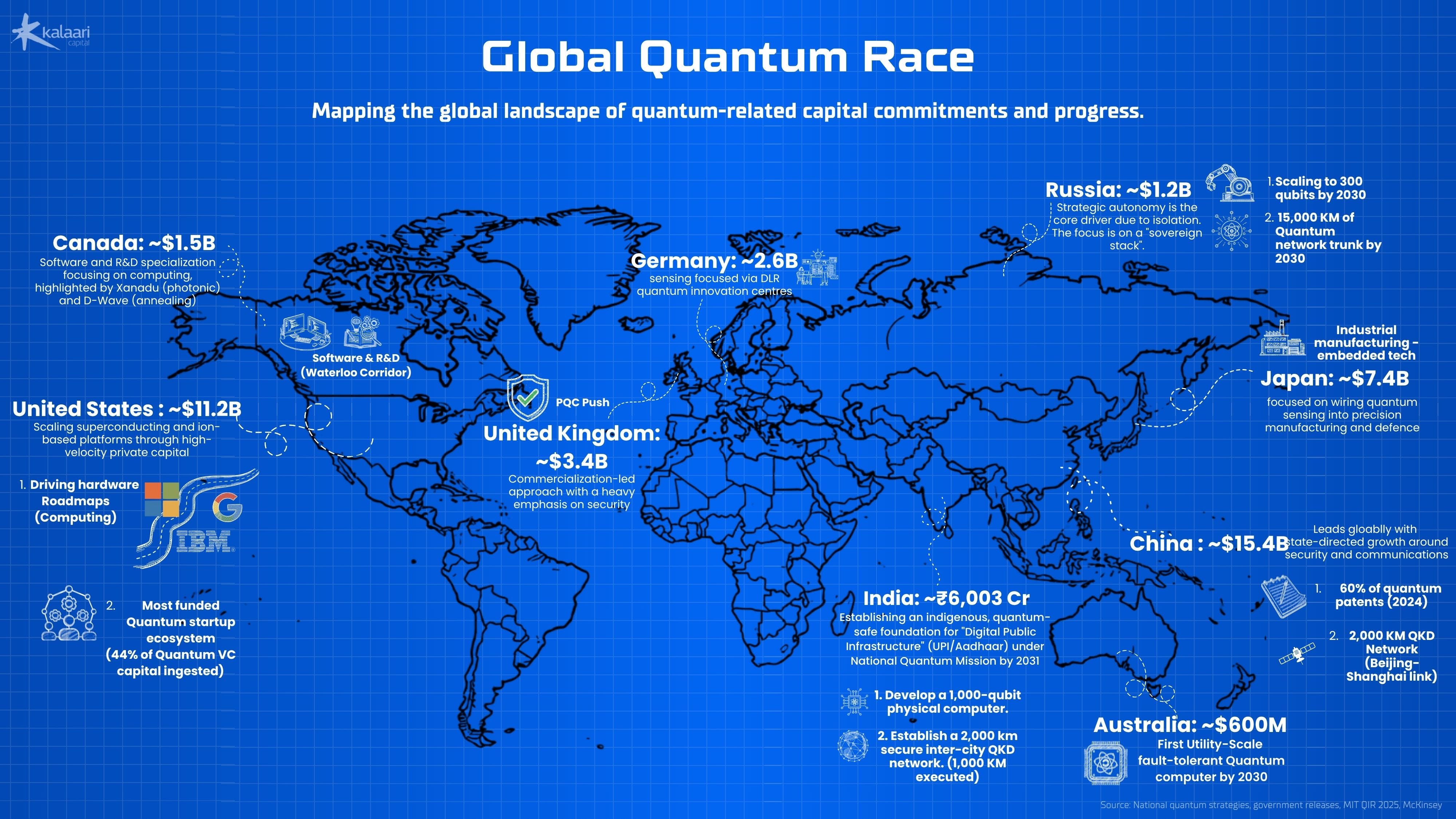
Governments have committed over $55 billion in public quantum funding since 2013, not as research grants, but as strategic infrastructure bets on exactly that compounding effect.
- China (~$15.4B): Built a 2,000km quantum-secured link between Beijing and Shanghai and the Micius satellite distributing quantum keys from orbit. Holds 60% of all global quantum patents as of 2024 and is writing its own cryptographic standards rather than adopting NIST’s.
- US (~$11.2B): NIST has defined the standards and mandated that all federal agencies migrate to quantum-safe cryptography by 2035. Post-quantum standards are not optional, every allied government, bank, and technology vendor selling into regulated markets will migrate to them.
- Japan ($7.4B): Not betting on building the fastest quantum computer. Wiring quantum sensing and simulation into precision manufacturing, advanced materials, and defence, industries Japan already dominates.
- Europe (>$13B collectively): Hedging across qubit architectures so that whichever approach wins, superconducting, trapped-ion, photonic, neutral-atom, at least one European champion is in the leading pack. After watching cloud and advanced chip manufacturing consolidate elsewhere, Europe is treating quantum as the strategic layer where it intends to hold sovereign capability from the start.
- India (₹6,003 crore through 2031): Made a deliberate choice to prioritise communication infrastructure first, and is already operating one of the longest QKD networks in the world, built on indigenous technology, ahead of schedule.
Where India Stands
India made a deliberate strategic choice most nations did not: prioritise communication infrastructure first. Quantum computers are still experimental and years from practical deployment. Quantum communication works today. While other countries bet heavily on computing hardware, India’s National Quantum Mission funded four Thematic Hubs, IISc Bengaluru for computing, IIT Madras and C-DOT for communication, IIT Bombay for sensing, IIT Delhi for materials, and put its early capital into infrastructure India could actually use now. Just last week, QNu Labs, an Indian startup backed by NQM, demonstrated a 1,000km quantum-secured communication network using entirely indigenous technology, one of the longest QKD deployments in the world, completed well ahead of its eight-year schedule.
India’s position looks different depending on which layer of the value chain you examine.
- Supply layer: Cryogenic electronics, precision optics, single-photon detectors, qubit fabrication, today almost the entire supply layer is imported. This is the strategic vulnerability equivalent to rare earths. Startups are beginning to address this. Quan2D Technologies in Bengaluru is building indigenous single-photon detectors. DimiraTechnologies is developing cryogenic cables. Quanastra is working on cryogenic systems and superconducting detectors. The gap is large, and the opportunity is real.
- Platform layer: QpiAI has launched India’s first full-stack quantum computer, the 25-qubit Indus, with a 64-qubit system, Kaveri, unveiled in November 2025 and targeted for commercial availability in 2026. C-DOT built an indigenous QKD platform with post-quantum compatibility from the start.
- Application layer: QNu Labs’ QShield platform, combining QRNG, QKD, PQC, and quantum hardware security modules, is deployed in defence, banking, and telecom. BosonQ Psi generates commercial revenue from quantum-inspired simulation. QuBeats won is working on quantum GPS-free navigation. Quantum AI Global, recently added to NQM’s cohort, is working on quantum memory and positioning systems.
Three Structural Advantages No Budget Can Replicate
First: digital infrastructure at scale. UPI, Aadhaar, DigiYatra, built on modern standards in the last decade, make quantum-safe migration a modernisation, not a retrofit. The RBI’s 2025 authentication directions create a concrete regulatory trigger. India processes more digital payments than almost any other nation. The country that migrates the world’s largest real-time payment system to post-quantum standards becomes the most compelling reference customer in the global PQC market.
Second: live defence demand. India’s contested frontiers generate persistent, funded procurement for quantum sensing and secure communications. DRDO has capability but not bandwidth. BEL and HAL are integrators, not innovators. Free-space QKD is not a lab experiment here, DRDO and IIT Delhi demonstrated it over a km link in June 2025, viable for battlefield deployments where no fibre exists. That supplier gap is structural, and the startup opportunity is persistent.
Third: talent. Algorithm depth at IITs, IISc, and TIFR is globally competitive. Hardware engineering talent exists, but it sits inside DRDO and ISRO. Founders who can pull that talent into startups access world-class capability at a fraction of Western cost.
Building in Quantum? We Would Love to Hear From You
The next three years are quantum's foundation phase, for India and for the companies building its infrastructure. The regulatory triggers are live. The defence demand is funded. The migration timelines are set. If you're building in quantum sensing hardware, PQC infrastructure, quantum networking, quantum-inspired software, or supply chain components, write to us at deeptech@kalaari.com.


.svg)

.svg)

More
NEWSLETTERS
.png)


