


.svg)

.svg)
%203.svg)


Nuclear Goes Private: India’s SHANTI Announcement


In October 2024, Google signed the world’s first corporate nuclear power purchase agreement - 500 MW from Kairos Power’s small modular reactors, expected by 2035. Days later, Amazon committed $500 million to X-energy. Microsoft signed a 20-year deal to restart a dormant Pennsylvania nuclear plant. Meta has also announced plans which by January 2026 add up to 6.6 GW of nuclear capacity in the U.S.
Countries moved too. Since 2023, France revived its nuclear buildout after a decade of pause. Japan restarted 17 reactors post-Fukushima. In December 2025, India passed the SHANTI Bill (Sustainable Harnessing and Advancement of Nuclear Energy for Transforming India), ending a 60-year government monopoly and opening nuclear power to private capital for the first time.
These moves are not isolated. They reflect a convergence of three forces: AI’s exponential energy demand, renewed urgency around energy sovereignty, and climate commitments that require reliable baseload power - bringing nuclear back to the centre of global energy infrastructure strategy.
The Energy Race: Why Nuclear Is Back
AI’s Power Surge
As the global AI race accelerates, there is an increasing spotlight on the infrastructure that is critical to support it. AI is profoundly compute-intensive - training models, processing queries, running inference continuously across hyperscale data centres. Sustaining this network demands enormous, uninterrupted energy.
India’s data center capacity is set to grow nearly 10x - from 960 MW in 2024 to 9.2 GW by 2030, consuming 3% of India’s total electricity versus less than 1% today.
This surge is reshaping energy decisions. Tech giants have already signed billion-dollar contracts to restart or build reactors - bringing significant private capital into a sector that was previously government-dominated, making nuclear commercially attractive again, not just strategically important.
Energy Security
Recent geopolitical tensions have exposed the fragility of energy supply chains. Countries dependent on imported fossil fuels saw prices spike and supply disrupted, underscoring that energy sovereignty isn’t optional - it’s strategic. India imports 47% of its energy today. For economies with ambitious growth targets, that dependency is a vulnerability.
Nuclear uses domestic fuel sources (uranium requires lesser imports compared to oil and gas), insulates nations from volatile commodity markets, and can’t be weaponized through pipeline politics.
Climate Commitments Without Compromise
India pledged net-zero by 2070. The EU targets 2050. China aims for 2060. Meeting these commitments while growing economies requires baseload power that renewables alone can’t provide. Nuclear operates at 90-93% capacity year-round, while Wind and solar average 20-35%. To replace coal without sacrificing industrial growth, nuclear isn’t optional - it’s necessary.

Why Nuclear Works for AI
AI infrastructure demands four non-negotiable requirements:
Reliability: Data centers require 99.99% to 99.999% uptime - downtime measured in minutes per year, not hours.
Solar produces zero power at night. Wind produces zero power when the wind stops. Both are intermittent by nature. Even with batteries, storing 12 hours of backup power for a large data center would be expensive. Coal and gas can run continuously, but their fuel supply chains are vulnerable to geopolitical disruption and price volatility.
Nuclear runs continuously for 18-24 months between refuelling at 90-93% capacity. Once fuel is loaded, it’s locked in - no daily shipments, no supply chain risk, no weather dependency.
Sustainability: Coal emits over 800g of CO2 per kWh. Solar and wind emit near-zero during operation but require massive land use and mineral extraction. Nuclear emits 10-15g per kWh lifecycle - comparable to wind and solar - with minimal land footprint.
Cost (System-level): Solar and wind have dropped dramatically in cost, but firming them with storage or backup raises system costs. Coal is cheap but carries carbon taxes and regulatory risk. Nuclear has high upfront capital costs but extremely low fuel costs and 40-60 year operating lives, making levelized costs competitive for baseload applications.
Scalability: Coal faces regulatory headwinds and permitting delays. Traditional large nuclear plants take 10-15 years to build - too slow for the AI boom. Small Modular Reactors (SMRs) change the nuclear equation: factory-built, 3-5 year timelines, right-sized for data center loads at 10-300 MW per unit. This makes nuclear potentially deployable at the pace AI infrastructure need.

In October 2024, Google signed the world’s first corporate nuclear power purchase agreement - 500 MW from Kairos Power’s small modular reactors, expected by 2035. Days later, Amazon committed $500 million to X-energy. Microsoft signed a 20-year deal to restart a dormant Pennsylvania nuclear plant. Meta has also announced plans which by January 2026 add up to 6.6 GW of nuclear capacity in the U.S.
Countries moved too. Since 2023, France revived its nuclear buildout after a decade of pause. Japan restarted 17 reactors post-Fukushima. In December 2025, India passed the SHANTI Bill (Sustainable Harnessing and Advancement of Nuclear Energy for Transforming India), ending a 60-year government monopoly and opening nuclear power to private capital for the first time.
These moves are not isolated. They reflect a convergence of three forces: AI’s exponential energy demand, renewed urgency around energy sovereignty, and climate commitments that require reliable baseload power - bringing nuclear back to the centre of global energy infrastructure strategy.
So how does Nuclear actually work?
At its core, nuclear energy is about generating power from atoms themselves - specifically, from splitting them apart or fusing them together. It’s not intuitive that something so small could power entire cities, but atoms contain enormous energy locked inside. When released, a single uranium pellet the size of your fingertip produces as much energy as one ton of coal.
There are two ways to unlock this energy: fission and fusion. Fission splits heavy atoms (like uranium) apart in a controlled chain reaction - this is what powers reactors today. Fusion fuses light atoms together (deuterium and tritium), like the sun does. Fusion promises even greater energy density with minimal waste, attracting startups building toward what could become the next leap in energy technology.
For fission, which dominates today’s nuclear landscape, the process works as a flow from fuel to power:
Fuel Preparation: Uranium ore gets mined, processed into gas, then enriched to concentrate the energy-producing part. That enriched uranium is converted into ceramic pellets about the size of your fingertip, loaded into metal fuel rods, and bundled into fuel assemblies.
Power Generation: Inside the reactor, those uranium pellets split apart in a controlled chain reaction, releasing enormous heat. That heat boils water into steam which is used to spin turbines and generate electricity. It’s the same basic setup as a coal plant - boil water, spin turbines, make power - just with uranium instead of coal as the heat source.
Waste Management: After decades of use, spent fuel needs to be safely stored. This waste remains radioactive and requires secure containment. Eventually, the reactor itself needs to be carefully dismantled after 40-60 years of operation.

The Technology Shift Making This Possible
Nuclear energy isn’t new - but the technology has evolved dramatically in recent years, making it more viable for private capital and faster deployment.
Small Modular Reactors (SMRs) are the biggest structural shift. Smaller, modular, factory-built reactors reduce construction timelines and financing risk. The breakthrough: they cool themselves using gravity and natural convection - no pumps, no external power needed. This simplifies the architecture and enhances safety, making them inherently more resilient while enabling scalable, factory-based manufacturing. China completed the first commercial SMR in 2023. Canada and the U.S. have approved new designs with committed buyers.
Fuel technology is also improving. Higher-concentration uranium allows reactors to run longer between refuelling cycles, reducing operational complexity. Supply chains for these advanced fuels are forming - the US Department of Energy has committed to producing significant quantities by 2026, and new manufacturers are emerging with private funding.
Fusion approaches are also advancing, though they remain pre-commercial. Laser-based inertial confinement (like the National Ignition Facility’s 2022 breakthrough achieving net energy gain) and magnetic confinement (tokamaks) are both seeing progress.
The convergence of modular design, advanced materials, and digital systems makes nuclear investable in ways it wasn’t a decade ago.
The SHANTI Bill: Opening the Fortress
In December 2025, India passed the SHANTI Bill, ending a 60-year government monopoly on nuclear power. For the first time since independence, private companies can build, own, and operate nuclear plants.
The bill signals India’s recognition that achieving energy security, meeting climate commitments, and powering AI-driven growth requires unlocking private capital and competitive execution. It’s India’s nuclear sector getting its 1991-style liberalization moment.
With only 8.8 GW of nuclear capacity built in 60 years - roughly 0.15 GW per year - hitting the 100 GW target by 2047 requires building at ~4 GW annually, a 27x acceleration. The bill propels this by opening nuclear to private capital, foreign technology partnerships, and market competition.
The key changes from the SHANTI bill fall into the below buckets:
Private Entry (With Boundaries)
Companies can now build reactors, generate power, fabricate fuel, and manufacture equipment while strategic activities stay 100% government: uranium enrichment beyond 20%, spent fuel reprocessing, high-level waste management. The commercial layer opens while sovereignty stays protected.
Liability Framework Fixed
The previous 2010 Civil Liability Act made suppliers liable for defects forever - even ones discovered decades later. The SHANTI Bill removes supplier liability except for explicit contracts or willful misconduct. Operator liability now scales with reactor size: ₹100 crore for small plants up to ₹3,000 crore for large ones. India now aligns with international standards used by the US, France, and Japan. This is viewed as much more favourable and acceptable terms for vendors to finally enter the market.
Real Regulatory Authority
The nuclear watchdog - Atomic Energy Regulatory Board (AERB) operated via executive order without formal independence. It now gets statutory status, independent budget, and parliamentary accountability. As private operators scale up, credible safety oversight becomes critical for both public trust and investor confidence.
R&D Unleashed
Nuclear research previously needed heavy pre-approvals from the Department of Atomic Energy. Now R&D for peaceful purposes is largely delicensed except for strategic areas. Startups can innovate on reactor designs, materials science, and safety systems without regulatory bottlenecks upfront.
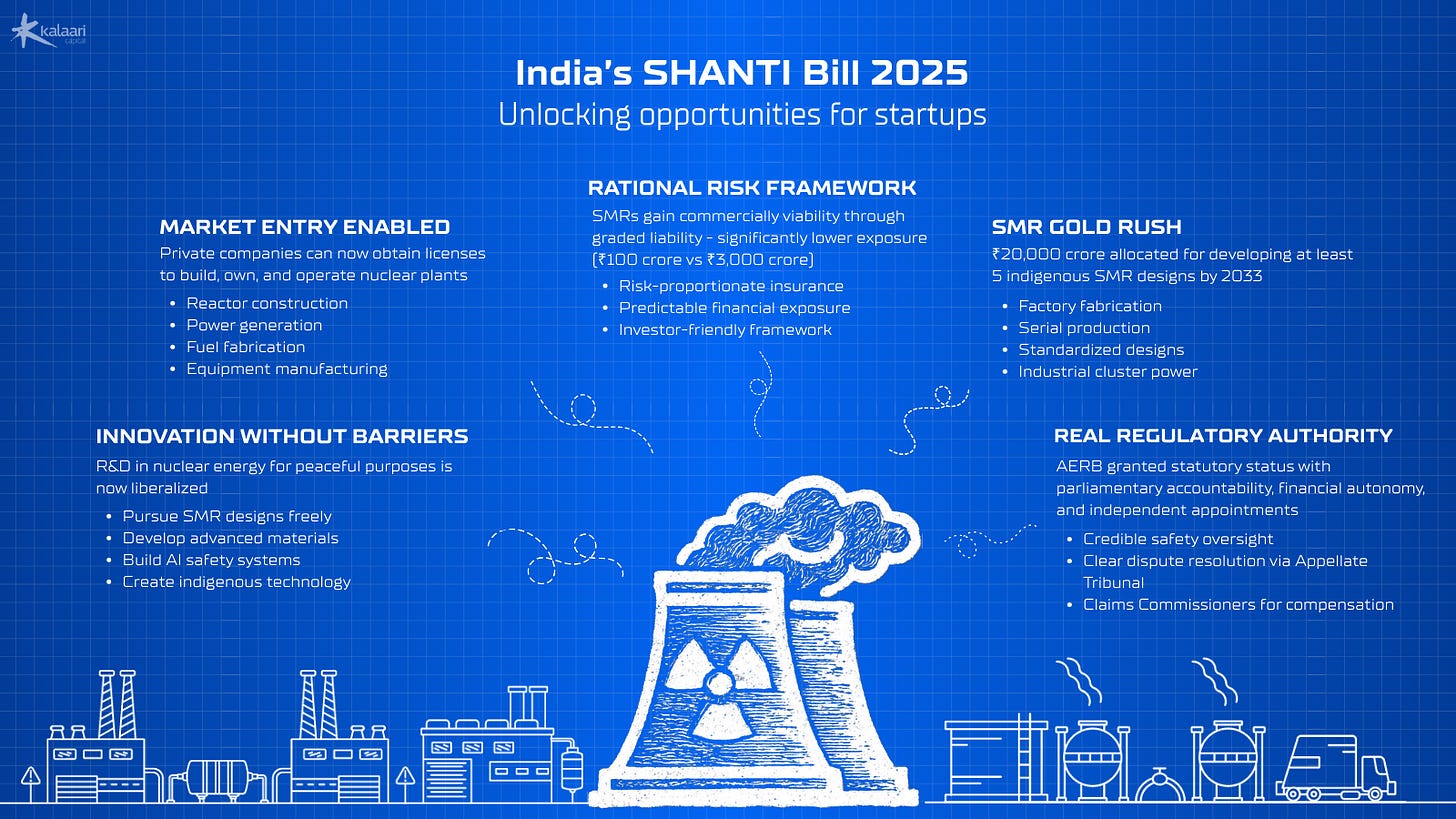
The bill sets progressive targets: 22 GW by 2032, 47 GW by 2037, 67 GW by 2042, and 100 GW by 2047. The government allocated ₹20,000 crore to develop at least five indigenous Bharat Small Modular Reactors by 2033.
The Indian market is already responding. Tata Power is evaluating SMRs and potential sites under the new regulatory framework, while Jindal Nuclear has articulated plans for up to 18 GW of capacity over the next two decades, spanning modular and advanced designs. The Adani Group has also formed a nuclear-focussed subsidiary and is exploring SMR projects.
The fortress is now open.
The Startup Opportunity
The nuclear startup ecosystem in India is nascent. While on the onset the nuclear market may seem like heavy capital deployments that only industry giants can do, startups will actually play a critical role in the modern nuclear supply chain which is much more modular.
1. SMR Design & Advanced Reactors
With smaller, modular technology stacks, deeptech startups could be the ones bringing cutting-edge reactor designs to market - whether through indigenous development or partnerships with international technology providers.
India committed to five indigenous reactors by 2033 but needs dozens more for 100 GW by 2047. Designs needed for molten salt reactors, high-temperature gas reactors, thorium-based systems (India has the world’s largest thorium reserves). The opportunity spans design software, simulation tools, digital twins, and AI-based optimization for reactor performance and safety.
Beyond fission, startups are also pursuing fusion-based approaches. Hylenr Technologies is pursuing Low Energy Nuclear Reactor (LENR) technology based on cold fusion principles, while Pranos and Anubal Fusion are working on advanced fusion concepts like Magnetic Confinement (MCF) and Inertial Confinement (ICF) respectively aimed at achieving commercially viable, high-density energy. While fusion remains less mature and years from commercial viability, these efforts represent potentially disruptive plays that could reshape the entire energy landscape if successful.
2. Manufacturing & Components
The component supply chain is currently dominated by China, Russia, and France, creating a massive import substitution opportunity.
For fission reactors, specific needs include precision-machined reactor vessel components, advanced alloys withstanding radiation and heat, instrumentation and control systems, fuel rod assemblies, coolant pumps, and heat exchangers.
For fusion, opportunities include high-power laser systems, superconducting magnet fabrication, vacuum vessel manufacturing, and plasma-facing materials. Hylenr’s laser facility in Hyderabad is an example of fusion-specific infrastructure being built in India, creating demand for specialized precision optics and high-energy laser components.
The customer list is already forming: NPCIL, Tata, Jindal, and international vendors localizing operations. L&T, BHEL, and Godrej are positioning for reactor fabrication.
3. Safety & Ancillary Systems
Multiple private operators mean distributed monitoring requirements. AERB needs scalable oversight technology as the sector expands.
Products needed include real-time radiation detection sensors (IoT-enabled), AI-based anomaly detection for predictive maintenance, inspection systems, remote monitoring dashboards for regulators, and cybersecurity for nuclear control systems.
Building for the Long Arc
From here to truly commercial deployments, this is a greenfield ecosystem that will take gestation.
Core reactor technology faces the longest development cycles. New designs whether fission-based SMRs or fusion approaches need to demonstrate stability, showcase performance under real-world conditions, and pass rigorous regulatory and safety reviews before they can be deployed at scale. First indigenous SMRs are targeted for 2033, but even those timelines assume successful technology validation and AERB certification.
The enabling infrastructure is being built in parallel. Regulatory frameworks are being written now. Standards for private operators, inspection protocols, decommissioning requirements - these take years to establish and refine.
For startups, this means building strategic partnerships early with institutions like NPCIL, BARC, and AERB and planning for patient capital. We’re keen to engage with Indian deeptech startups building across any part of the nuclear value chain - from core reactor technology to components, monitoring systems, safety solutions, and enabling infrastructure. If you’re working in this space, we’d love to hear from you at deeptech@kalaari.com.
This is 2025’s foundation for 2035’s outcomes. The law named “peace” has sparked a race. It’s a marathon, not a sprint but the starting gun just fired.


.svg)

.svg)

More
NEWSLETTERS
.png)


